Archive

Saved by the Stuff of Grace

By Father Stephen Freeman, August 29, 2025 I can think of few phrases in modern Christian speech that have been more abused through misuse and overuse than “we are saved by grace.” As a young Protestant, this was explained to me thus: “We are saved by God’s unmerited favor.” This has the unfortunate implication that, whatever salvation may be, it’s something that’s happening in the mind of God – His unmerited favor. It strikes me
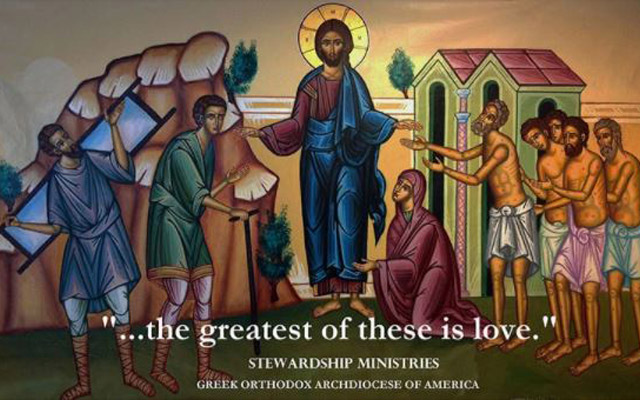
Love and Being

~By Fr. Stephen Freeman, July 21, 2025 Perhaps the most intriguing statement in the New Testament is St. John’s simple, “God is love.” As mysterious and awesome as the revelation of the Divine Name (“I am that I am”) to Moses might be, St. John’s statement gives a content that echoes and enfolds the death and resurrection of Christ itself. Indeed, any other statement about God runs the risk of obscuring this essential revelation. More

The Third Friday of Great Lent: The Eternal Cross-How Is the Lamb Slain from the Foundation of the World?

~By Father Stephen Freeman, April 20, 2022 Among the many striking images in the book of Revelation, there is one that stands out in particular. In Chapter 13, vs 8, we read: “All who dwell on the earth will worship him [the beast], whose names have not been written in the Book of Life of the Lamb slain from the foundation of the world.” The passage is not unlike that in 1 Peter: “knowing that you

Orthodoxy Versus Christian Materialism (Part III)

By Father Stephen Freeman Time is not Time-Bound Among the least appreciated aspects of classical Christian thought is its treatment of time. It is an understanding that is necessitated by the treatment of time within the Scriptures themselves and not by some alien metaphysic. It is Christ Himself who most reveals time in its proper perspective. He is both Beginning and the End (Rev. 1:8). This is not at all the same thing as saying that He

Orthodoxy Versus Christian Materialism (Part II)

By Fr. Stephen Freeman The Orthodox View of the World As noted earlier, there are certainly Orthodox whose ideas differ little from this “materialist” Christianity. Their sacramental view is just as external as other materialists, their understanding of relationships just as psychological. They defend the Orthodox “meaning” but see this as simply correct thought. They can be highly moralistic and deeply committed to God as the cosmic enforcer. Many are as defensive of the historically

Why We Forgive

By Fr. Stephen Freeman, March 14, 2016  There are many ways to think about forgiveness, not all of them true or helpful. It is easily the most emotionally and psychologically difficult aspect of the Christian life revealing both the power of trauma as well as the tenacity of lingering memories. The directness of Christ’s commandments (“forgive your enemies”) and the consequences of ignoring them (“if you do not forgive others neither will your heavenly Father

The Extraordinary Love of God

Sermon preached by Fr. Antony Hughes on Sunday, September 29, 2013 Luke 6:31-36 (2nd Sunday of Luke) Again we are reminded that God is merciful and compassionate and that we are to follow his example, but this is more than mere imitation.  The imitation of God is one thing, but we are called to do more than that; we are called to become divine, not just to be merciful, but to become Mercy.  The transformation

Being Saved – The Ontological Approach

By Fr. Stephen Freeman, August 12, 2016 I cannot begin to count the number of times I wished there were a simple, felicitous word for “ontological.” I dislike writing theology with words that have to be explained – that is, words whose meanings are not immediately obvious. But, alas, I have found no substitute and will, therefore, beg my reader’s indulgence for dragging such a word into our conversations. From the earliest times in the

Why We Forgive

By Fr. Stephen Freeman, March 14, 2016  There are many ways to think about forgiveness, not all of them true or helpful. It is easily the most emotionally and psychologically difficult aspect of the Christian life revealing both the power of trauma as well as the tenacity of lingering memories. The directness of Christ’s commandments (“forgive your enemies”) and the consequences of ignoring them (“if you do not forgive others neither will your heavenly Father

Christ and Nothing (Part VIII)

By David Bentley Hart, October 2003 I am tempted to say, then, that the cross of Christ is not simply a sacrifice, but the place where two opposed understandings of sacrifice clashed. Christ’s whole life was a reconciling qurban: an approach to the Father, a real indwelling of God’s glory in the temple of Christ’s body, and an atonement made for a people enslaved to death. In pouring himself out in the form of a