Archive

God and the Fourth of July

Asked to propose a national seal in 1776, Franklin and Jefferson chose religious themes. By Meir Soloveichik, July 1, 2016 5:18 pm ET On July 4, 1776, after voting to approve the Declaration of Independence, the Continental Congress advanced the following resolution: “That Dr. Franklin, Mr. J. Adams and Mr. Jefferson, be a committee, to bring in a device for a seal for the United States of America.” Of these three founders, two suggested seals that

The Presentation and the Crucifixion

Metropolitan Anthony Bloom of Sourozh (Extract from a sermon preached at the University Church of Great St Mary’s, Cambridge, on 19 May 1985) And then, lastly, two events which I would like to bring together. The Presentation of Jesus in the Temple and the Crucifixion. Every male child first-born of a woman was to be brought to the Temple as an offering. If we read back into the Old Testament about the institution of the

The Fifth Friday of Great Lent. We Have You as an Example of Repentance, Mary the Egyptian

Hierodeacon Rafael Misiaoulis, Theologian On the fifth Sunday in Lent, the Church brings to our attention an exceptional female ascetic: Saint Mary the Egyptian. She’s someone for us to imitate and has a great deal to teach us. Her Life was preserved for us by Saint Zosimas and written down by Saint Sofronios, Patriarch of Jerusalem (commemorated on 11 March). Saint Mary lived at the time of the Emperor Justinian, in the sixth century, in

The Feast of Christ’s Reception as Fulfillment of the Ritual of Mosaic Law

~Theodore Rokas The recent feast, the Reception of the Lord, is the feast which is celebrated exactly forty days after that of His Nativity. The name of the feast in Greek comes from a verb meaning ‘to go out and meet or welcome someone’ [Hence the depiction of Symeon in icons as being at or outside a door. WJL]. As regards the determination of the celebration of the feast on 2 February, this was decided

Venerable Maximus the Confessor

Saint Maximus the Confessor was born in Constantinople around 580 and raised in a pious Christian family. He received an excellent education, studying philosophy, grammar, and rhetoric. He was well-read in the authors of antiquity and he also mastered philosophy and theology. When Saint Maximus entered into government service, he became first secretary and chief counselor to the emperor Heraclius (611-641), who was impressed by his knowledge and virtuous life. Saint Maximus soon realized that

Venerable and God-bearing Father Anthony the Great

Saint Anthony the Great is known as the Father of monasticism, and the long ascetical sermon in The Life of Saint Anthony by Saint Athanasius (Sections 16-34), could be called the first monastic Rule. He was born in Egypt in the village of Coma, near the desert of the Thebaid, in the year 251. His parents were pious Christians of illustrious lineage. Anthony was a serious child and was respectful and obedient to his parents.

The Second Day of Christmas. The Synaxis of the Most Holy Theotokos

~By Archimandrite Kirill (Pavlov), 1/8/2019 Translation by Nun Cornelia (Rees) In the name of the Father, the Son, and the Holy Spirit! Dear brothers and sisters, today we celebrate the second day of the great feast of the Nativity of Christ. This day is called the day of the Synaxis of the Most Holy Theotokos, because in antiquity, on the second day of the feast of the Nativity of Christ the first Christians gathered in the

A Christmas Sermon by St. Gregory of Nazianzus (AD 380)

~Sermon preached by St. Gregory of Nazianzus (AD 380) Christ is born, glorify Him. Christ from heaven, go out to meet Him. Christ on earth, be exalted. Sing to the Lord all the whole earth; and that I may join both in one word, let the heavens rejoice, and let the earth be glad, for Him who is of heaven and then of earth. Christ in the flesh, rejoice with trembling and with joy; with

The Twentieth Day of Christmas Advent. Saint Barbara the Great Martyr

Saint Barbara was from Heliopolis of Phoenicia and lived during the reign of Maximian. She was the daughter of a certain idolater named Dioscorus. When Barbara came of age, she was enlightened in her pure heart and secretly believed in the Holy Trinity. About this time Dioscorus began building a bath-house; before it was finished he was required to go away to attend to certain matters, and in his absence Barbara directed the workmen to

The Stewardship of St. John the Merciful

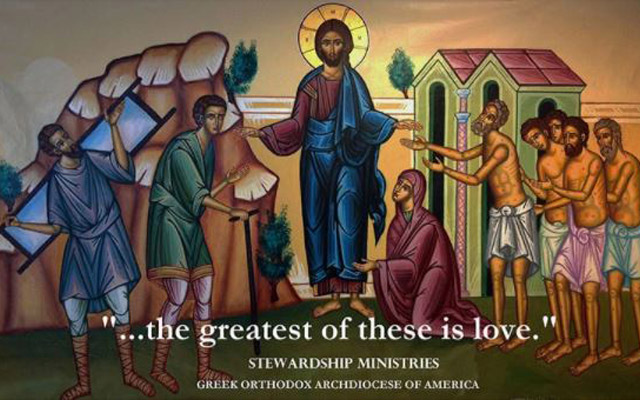
“We will soon see, Lord, which of us two will win the contest: You, Whoever gives me good gifts, or I, who will never cease distributing them to the poor. For I know well there is nothing of mine that is not owing to Your mercy, which upholds my life.” (Prayer of St. John the Merciful) Born in the year 555 on the island of Cyprus, the saint we remember on November 12 is a