Archive

Look Who’s Talking

~By Fr. Stephen Freeman, August 6, 2025 In the Transfiguration, Christ is seen speaking with Moses and Elijah on the top of a mountain, shimmering with a light of unbearable brightness. It is an event unlike anything else in the gospels, deserving the Great Feast that is associated with it. That Christ is seen speaking with Moses and Elijah is itself an affirmation that in Him, the whole of the Law and the Prophets find
Sunday of the Blind Man

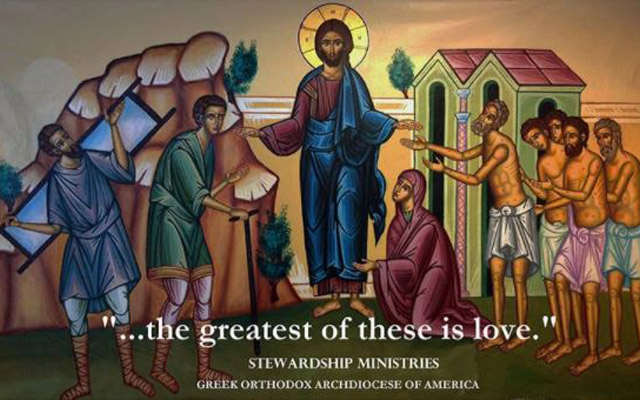
ΧΡΙΣΤΟΣ ΑΝΕΣΤΗ! CHRIST IS RISEN! At the end of Chapter 8 in Gospel of Saint John, the Savior was disputing with the Pharisees in the Temple during the Feast of Tabernacles. He told them, “Your father Abraham was glad that he should see my day; and he saw it and rejoiced” (John 8:56). The Jews said that Jesus was not even fifty years old, so how could He claim to have seen Abraham? The Lord

Sunday of Orthodoxy. The Theology of the Holy Icons

Hierodeacon Rafael Misiaoulis, Theologian On the first Sunday in Lent we celebrate the restoration of the holy icons. The Church celebrates. Orthodoxy celebrates. The human race celebrates, since all of us are made in the image (icon) of God. The Church confesses in a variety of ways. It gives a confession of faith through words, deeds and symbols. With the body, soul and spirit. And also through the holy icons. On this day we honor

The Light Shines in the Darkness

~Sermon Preached by Fr. Antony Hughes on Sunday, January 14, 2007 In the Name of the Father and of the Son and of the Holy Spirit, one God. Amen. Glory to Jesus Christ! Galilee has an interesting history. The name comes from the Aramaic word “gal” which means “to take captive.” In the year 721 BC the Assyrians took over the Northern kingdom of Israel comprised of ten of the twelve tribes of Israel. The

Are We Connected?

~By Father Stephen Freeman, August 30, 2023 How connected are we? Do your actions, thoughts, feelings, have an effect on me even if I am unaware (or on the other side of the world)? Is my existence bound within the existence of other human beings, or are we simply sharing the same planet for a period of time? Connections between people, particularly of a spiritual nature, were declared to be mere superstitions in the march

On the Icon of the Nativity of the Theotokos

Sermon preached by Melissa Nassiff on Sunday, March 4, 2018 at St. Mary Orthodox Church in Cambridge, MA. In the name of the Father, and the Son, and the Holy Spirit. Good morning! Once again March is Antiochian Women’s month, and throughout the Archdiocese, women are serving their parishes in some of the more visible ways: taking the collection, taking part in the Great Procession, ushering, assisting with communion, and giving a homily. Last year,

Mary: The Blessing of All Generations

By Fr. Stephen Freeman, August 7, 2019 In my childhood, it was not unusual to hear someone ask, “Who are your people?” It was a semi-polite, Southernism designed to elicit essential information about a person’s social background. The assumption was that you, at best, could only be an example of your “people.” It ignored the common individualism of the wider culture, preferring the more family or clan-centered existence of an older time. It was possible

The Dormition Fast: Why Mary Has Always Been Honored

By Fr. Stephen Freeman, August 13, 2018 This Wednesday (August 15) is the Feast of the Dormition, the Falling Asleep of the Virgin Mary. I offer this article as a reflection. The most difficult part of my Orthodox experience to discuss with the non-Orthodox is the place and role of the Mother of God in the Church and in my life. It is, on the one hand, deeply theological and even essential to a right understanding

The Dormition Fast: The Most Holy Mother of God

By Fr. Stephen Freeman, August 13, 2008  On August 15, the Orthodox Church (new calendar) commemorates the Dormition (falling asleep) of the Most Holy Mother of God. The feast is considered to be one of the 12 Great Feasts of the year and thus an integral part of the proclamation of gospel of Jesus Christ. Many who are not familiar with Orthodoxy, or its manner of understanding saints, easily see feast days and the veneration

Priesthood in the Old and New Testaments

Grigoris Sahinoglou The concept of priesthood exists in the Old Testament, though it has a significance and character that is different from that which it assumes in the New. In the Old Testament, before the time of Moses, every head of a family could offer sacrifices to God and there is no lack of instances where this happened, such as when Noah performed a sacrifice after the flood in gratitude to God for his survival